
What does it take to make a circular economy work?
Reflections on infrastructure, investment and the future of reuse from the Circular Economy Leadership Programme.
In September 2026, Sculpture Placement Group (SPG) and Circular Arts Network (CAN) Co-Directors Michelle Emery-Barker and Kate V Robertson, joined fellow participants from across Scotland for the Circular Economy Leadership Programme‘s international immersion visits to Amsterdam and Rotterdam. Delivered by Circular Glasgow in partnership with Circle Economy, with support from Scottish Enterprise, the programme brought together leaders working across different sectors to explore how circular economy principles can be translated into practice.
The two days offered an opportunity to learn from organisations developing circular approaches at different scales, from individual businesses and shared workspaces to city-wide strategies. But alongside examples of innovation, the visits also highlighted some of the practical and economic challenges involved in making circularity work.
Creating the conditions for reuse
The first visit took place at CRCL Park in Amsterdam, a large complex bringing together workshops, makers’ spaces, laboratories and shared facilities. Across the site, examples of modular design and repurposed materials demonstrated how circular principles could be incorporated into both the buildings and the activities taking place within them. A large events space, fitted with portable seating and other adaptable elements, offered a further example of how spaces can be designed for flexible use.
The programme also introduced Droppie, a container-based waste collection and recycling initiative. Developed with support from Circular Amsterdam and incubated at CRCL Park, the project uses a combination of sorting technology and a rewards system to encourage members of the public to return their waste. Users receive money in exchange, while the system collects information about the materials being deposited. Having established a successful model, the initiative was beginning to scale up across the city.
These examples demonstrated the value of bringing together innovation, practical infrastructure and municipal support. Circular initiatives don’t operate in isolation: they need places to develop, investment to grow and systems that make participation possible.
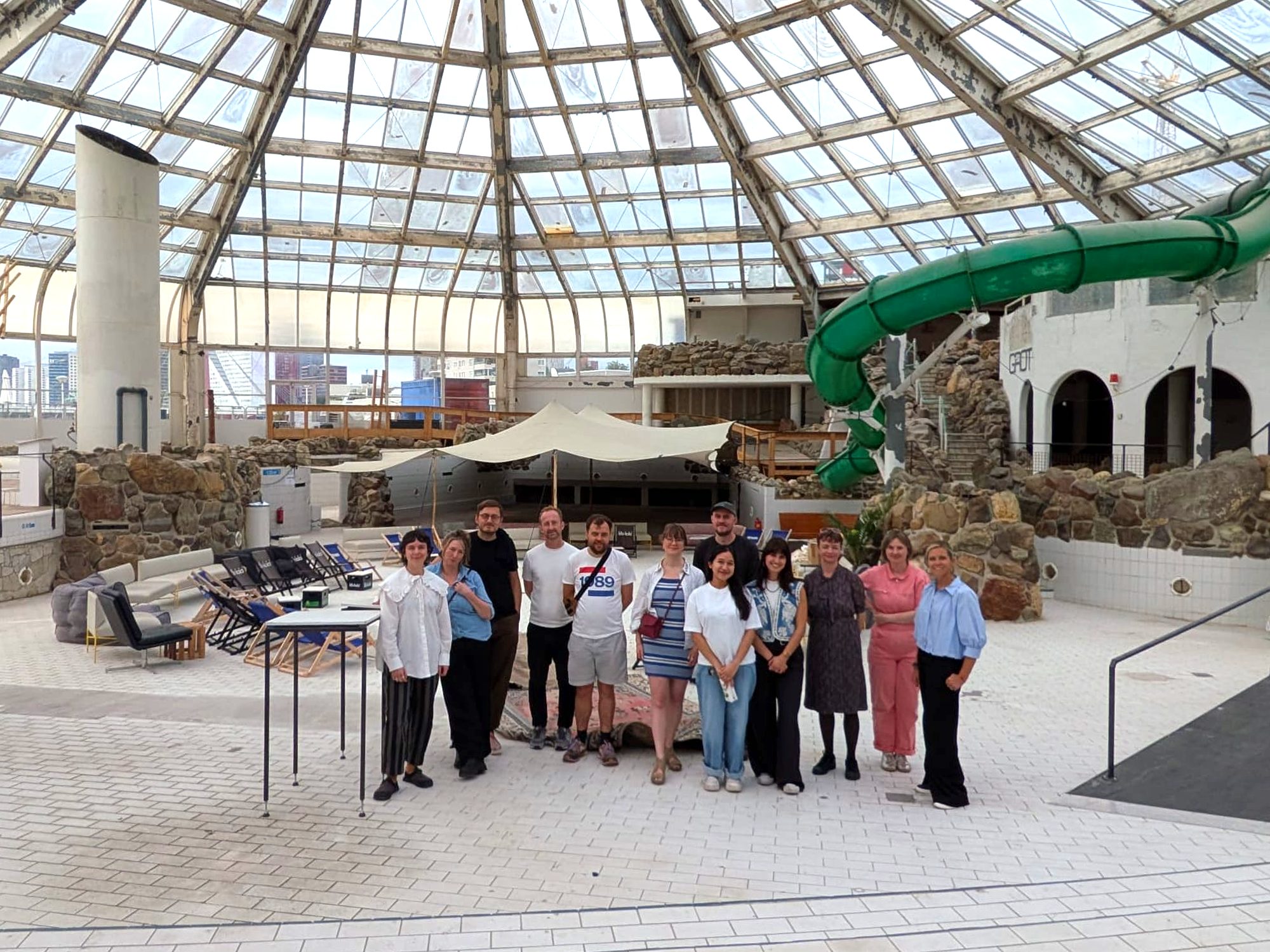
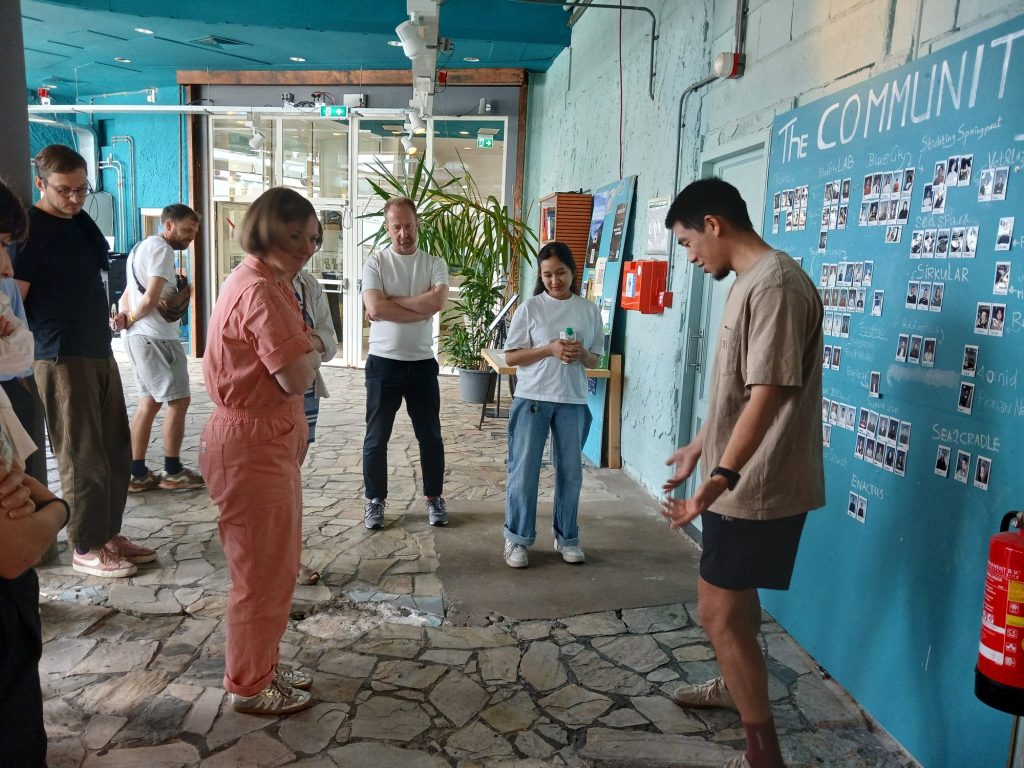
The following day’s visit to BlueCity in Rotterdam offered a different perspective. Housed within a former swimming complex, the building has been repurposed as an incubator for businesses exploring circular products and processes. The former pool, slides and distinctive architecture make it an unusual and memorable setting for this work.
However, the initial excitement of the building also prompted a more practical discussion about the realities of adapting and maintaining existing infrastructure. Its size and original design present considerable challenges, from managing temperature in the summer and winter to the ongoing costs of maintenance and operation. There were members of the visiting group with first-hand experience of occupying, adapting and maintaining older buildings, this was a useful reminder that repurposing a space is not necessarily straightforward. The long-term functionality and running costs of a building are just as important as the initial opportunity it presents.
Rethinking value
The presentations in Amsterdam and Rotterdam also raised questions about how we understand and measure value within the current economic system.
Discussion around the Circularity Gap Report highlighted the limitations of existing economic language and measurement, particularly the way discarded products, waste and lost material value are accounted for. Similar questions emerged during sessions on circular finance, where conventional understandings of risk, loss and value can fail to recognise the wider environmental and social costs that are often externalised by linear economic models.
Regional approaches to circularity offered some useful examples of how these challenges might be addressed. Friesland was presented as a model of a region developing a strong shared identity and direction around circularity, offering a potential point of reference for Glasgow. In Rotterdam, One Planet Port demonstrated how the particular characteristics of a place can become the basis for wider transformation. By understanding the Port of Rotterdam as a site with its own scale, infrastructure, knowledge and global reach, the initiative is exploring how established patterns of trade, commerce and supply chains might be reconfigured around more sustainable and equitable principles.
These examples reinforced the importance of working at different scales, recognising the particular conditions of a place while understanding its position within wider economic systems.
Building the infrastructure for change
One of the more significant takeaways was that leadership and ambition, while important, need to be supported by the right conditions. Policy and legal frameworks must enable change, and this requires sustained financial investment. Buildings, spaces and shared infrastructure are essential if circular approaches are to move beyond individual projects and become embedded in how organisations and industries operate.
The experience also offered reassurance. Many of the challenges encountered by organisations in the Netherlands were familiar, despite their longer experience and, in some cases, greater institutional support. Making circularity economically viable within a predominantly linear economy remains difficult. Understanding this helped put some of the challenges faced by SPG and CAN into perspective, and reinforced the importance of continuing to develop and advocate for this work.
The programme also brought together a cohort of people working towards related ambitions across different sectors. This shared experience created opportunities to exchange ideas, offer support and recognise the wider circular economy ecosystem developing in Glasgow.
For SPG and CAN, one ambition that has gained further momentum through these conversations is the need for a larger reuse hub and cultural production facility. Developed in collaboration with partners, supporters and advocates, this would provide more space and infrastructure for material reuse and cultural production, helping to strengthen the conditions in which circular practice can grow.
The programme also raised an important question about how this work will be funded. Circular and socially valuable enterprises often struggle to compete economically within existing systems, while public funding available to support cultural and social impact is increasingly limited. Developing stronger relationships with commercial partners will therefore be an important part of creating a more resilient model.
The visits to Amsterdam and Rotterdam demonstrated what can be achieved when circular thinking is supported by investment, infrastructure and collaboration. They also reinforced that lasting change requires more than individual innovation. It depends on the systems, spaces and relationships that allow different approaches to take root and develop over time.
SPG looks forward to continuing these conversations and working with others across Glasgow’s circular economy network to help turn shared ambitions into practical opportunities.