Sculpture Placement Group (SPG) are recruiting for an Engagement Officer to join our busy research team. The Engagement Officer will be required to develop, plan and deliver arts engagement work with communities across a number of SPG projects. It is a varied and flexible role based at SPG’s office in Glasgow but with a requirement to deliver work occasional off-site work in locations across Scotland.
About SPG
SPG is an action research organisation and Community Interest Company. All of our work is underpinned by our mission to design, pilot and share new ways of working so that artists are better supported, arts organisations work sustainably and more people get to experience art in their daily lives. We imagine a future where artists have great opportunities, everyone has access to art and the arts sector is sustainable. In addition to our ongoing projects, including Circular Arts Network (CAN), Team Sculpture and SPG Club, we also conduct ongoing research to develop new ways of working and find ways to share this within the sector. SPG is firmly committed to bringing art into people’s daily lives no matter their background or present circumstances.
The Role
The Engagement Officer role is a varied and the successful candidate will work across a number of projects. The role includes the following responsibilities:
Devise and deliver online and in person engagement activity for CAN – such as material sharing events, talks and workshops.
Support SPG’s Digital Marketing Officer to develop and commission digital materials and tools such as the ‘CAN Do’ film series
Attend and represent SPG and/or CAN at networking events and participate in educational, cultural and industry events
Develop and deliver 3 editions of Team Sculpture per year. These currently include 1 x a 10 week schools programme, 1 x a 6 week Community Group programme and 1 x a 6 week programme for care experienced young people in partnership with Barnardo’s
Engage with project partners and schools to identify and recruit participants for the Team Sculpture programmes
Programme and host online digital events and discussion for SPG Club, in consultation with SPG’s Digital Marketing Officer
Select and administer the donated memberships for SPG Club and prepare any supporting materials such as learning packs
Gather evaluation materials and where required work with third party orgs to undertake evaluation
Compile evaluation reports/film/digital content and consult with Digital Marketing Officer to make evaluation information public
Identify funding sources and complete funding applications to raise project funds, fundraising from sources including public funders and charitable trusts
Undertake reviews of the programme and develop new strands of work with new communities and project partners
Information
Desirable Criteria:
Prior experience of working in a similar role within the arts or another field would be essential in pursuing this role. You will have experience working with contrasting groups and communities, such as young people, older people and those facing disadvantage. You will have an appreciation of contemporary art and ability to communicate enthusiasm for the art-form. As you will be part of a very small team, the role would best suit candidates who enjoy undertaking a good deal of autonomy in their work. Good communication and interpersonal skills are also essential. Experience in developing programmes of engagement is also desirable as well as fundraising experience. A good understanding of participant-led evaluation processes and experience of implementing is also advantageous as would a driver’s license and access to your own car (mileage will be reimbursed).
Hours, Salary and Benefits:
This is a fixed term post of 3 days per week until March 2028. The salary is £29k (pro-rata 3 days).The role will be based at SPG’s in Glasgow’s city centre office, but occasional home working can be accommodated. As outlined already, you will occasionally be required to work at offsite locations. You will be enrolled in the company’s pension scheme and employer’s contributions will be made at 7.5%.
Timescales and How to Apply:
Deadline for application: 20th January 2026 at 5pm
Interviews: 5th February 2026
Successful Candidate Notified: 9th February 2026
Please apply for this role in writing including a covering letter (no more than 1 A4 sheet) and up-to-date CV. Your application should outline your past experience, why you are an ideal candidate for the job and what interests you in the role and working for SPG. Please also include contacts details of 2 referees in your application.
The interview process will involve a short 5-10 minute presentation on how you would see the Team Sculpture programme developing followed by a short interview with SPG’s Co-directors. More information on the Team Sculpture programme and SPG’s wider work can be found on our SPG and CAN websites.
References will be sought and PVG checks will be carried out once the role is offered. If you have any questions relating to applying please get in touch with us in advance of the application deadline.
Introducing ARMS: A New Way to Share and Manage Resources in the Arts
Posted on
At Sculpture Placement Group, we’re proud to be part of Arts Resource Management Scotland (ARMS) — a new sector-wide initiative designed to support more sustainable, collaborative approaches to managing physical resources across Scotland’s creative industries.
ARMS offers arts organisations practical services to help store, catalogue, and share everything from props and plinths to set pieces and technical equipment. The goal is simple: to reduce waste, increase access, and make better use of the resources already in circulation.
Working in partnership with IG Transport and Storage, ARMS provides secure, flexible storage alongside a powerful digital asset management system that allows users to track, tag, and share their inventory. Whether you’re storing a modular wall, a stack of risers, or a set of flight cases, the platform helps you stay organised while enabling reuse across organisations.
ARMS also offers 3D scanning services, allowing high-resolution digital models of objects to be created for archival purposes, design development, or reuse planning. These models can be embedded into websites, used in CAD workflows, or shared with curators, fabricators, and collaborators.
By helping organisations take care of what they already have — and making it easier to share those resources with others — ARMS is part of a wider shift toward more sustainable arts infrastructure. It’s a practical step toward circular working, and we’re excited to see how it develops.
Sculpture Placement Group is looking for a freelance web developer with experience in WordPress, Elementor, and CSS to support the implementation of a digital toolkit and accessibility improvements on our website.
We’re an arts organisation committed to ethical and inclusive practices, and we’re looking to work with someone who shares those values. This role would suit a developer who’s early in their career but has some solid experience — perhaps someone building their portfolio, or looking to work in more creative and socially-engaged settings.
About the Role
You’ll be working with our team to help:
Implement accessibility recommendations from a recent audit.
Support the development and online publication of a digital toolkit related to our Loan project.
Make small but meaningful structural, visual, and navigational changes (mostly within Elementor and WordPress), with some custom CSS involved.
This includes tasks such as:
Adding alt text and improving image descriptions across the site.
Improving focus order and keyboard navigation.
Adjusting heading levels and labels for screen readers.
Ensuring link clarity and fixing broken links.
Restructuring content for better readability and logical organisation.
Supporting the creation and styling of a toolkit pages.
Skills required
Solid working knowledge of WordPress (admin and theme management).
Experience with Elementor (or willingness to learn fast).
Understanding of CSS and ability to make minor custom adjustments.
Familiarity with accessibility best practices (or eagerness to learn and apply recommendations with guidance).
Comfortable working collaboratively and responsively via email or shared documents.
Desirable
Interest in the arts, culture, or socially engaged work. Based in Scotland. Experience working in line with values of equity, inclusion, and fair work principles.
Time Commitment
We estimate this project will require around 4–6 days of work spread flexibly over 3–4 weeks, depending on availability and working speed. We’re open to discussing the scope and approach with the selected person.
Pay
This is a freelance role, pay is £1200. We are committed to fair and prompt payment.
How to Apply
Please email us a short introduction to yourself, along with:
Examples of relevant work or a portfolio (can be simple or informal)
Contact: josh@sculptureplacementgroup.org.uk Deadline to apply: 31 May 2025
Sculpture Placement Group (SPG) is a research-led organisation working within the visual arts. Our projects aim to improve economic conditions for artists, broaden public access to contemporary art, and address the wasteful commissioning cycles that frequently end with artworks being shown once and then discarded. As co-director Kate V Robinson notes, “we want to bring art to new audiences, make it more accessible, and address the waste in commissioning an artwork that gets shown once and then binned.”
About Floating Head
Floating Head is a 26-tonne floating sculpture originally commissioned for the 1988 Glasgow Garden Festival. Conceived by artist Richard Groom and fabricated with shipbuilders at Govan Docks, it combines steel mesh with cement render, embedding Glasgow’s industrial materials and heritage directly into its construction.
The Garden Festival itself drew over 4.3 million visitors and marked a pivotal moment in Glasgow’s transition from post-industrial decline toward cultural regeneration. Many of the artworks commissioned or loaned for the festival have since disappeared with little documentation. Groom’s Floating Head, however, survived—first by chance, and later through acts of private intervention. The sculpture’s survival tells a parallel story to the site: once a thriving dockyard, later derelict, and now home to BBC Scotland and the Glasgow Science Centre.
The Artist: Richard Groom
Richard Groom trained in stone carving, contributing hand-carved ornament to major Scottish buildings such as Paisley Abbey before moving into more experimental sculptural work. After his death in 2019, his brother, Andy Groom, set out to locate the Floating Head following strong recollections of the piece shared at Richard’s funeral. This personal motivation became the starting point for the sculpture’s rediscovery.
Our Aims
SPG had already been investigating the legacy of the Glasgow Garden Festival and the broader question of what happens to artworks after major cultural events. The festival’s nostalgic pull and its significance to the city made it an ideal case study for examining commissioning practices and legacy planning.
Our research focuses on artworks in storage and the long-term responsibility for their care. Floating Head aligned closely with these interests. Once Glasgow City Heritage Trust connected SPG with Andy Groom, the project gained momentum and raised new questions.
What should be considered at the point of commissioning to ensure future care?
How do we extend the life of public artworks?
Is Floating Head’s survival the result of chance, or of committed individuals?
Ownership and Rediscovery
After the Garden Festival, Floating Head was stored on land later purchased by Ian Henderson, who became its owner. When the site was being cleared, Keith from Offshore Works Ltd intervened, towing the sculpture to safety at Clyde Boatyard, where it remained for years—weathered, moss-covered, partially re-rendered, and marked by graffiti.
During planning for its re-emergence, several potential long-term destinations were explored, including museum acquisition. However, private owners who have expended resources preserving a work may not wish to relinquish it, creating tensions around stewardship, responsibility, and public access.
Conservation
Conservation was carried out by a small team of specialists, including Concrete Repairs Limited, who donated materials and provided discounted labour. Repairs were intentionally minimal and focused below the waterline to make the sculpture watertight without compromising its original render. Graffiti was removed, and the work stabilised for refloating.
Fundraising
The project cost approximately £27,000, supported by:
CITB (£6k)
Glasgow City Heritage Trust (£5k for engagement)
Awards for All (£7k for the sculpture trail)
Sustrans (£2.5k)
Crowdfunder (£7k) including £1.5k Creative Scotland Crowdmatch
The crowdfunder brought significant public engagement and extended the project’s reach through press support and storytelling.
Workshops and Public Engagement
SPG partnered with Glasgow Science Centre to run workshops, beginning with Curiosity Live in March 2020, where over 300 schoolchildren made floating sculptures.
During COVID, activity moved online. Artists Ruby and Greer Pester and boatbuilder Jason Bradley delivered remote workshops for Govanhill Development Trust and Glasgow Disability Alliance, whose participants created floating sculptures later launched in the Science Centre moat during the official event.
Display and Launch
COVID significantly delayed the sculpture’s return to the Clyde. During this time, SPG produced a virtual tour for Glasgow Doors Open Day, helping share the story widely while physical access was limited. Negotiations around mooring rights, liabilities, and maintenance proved complex, resulting in a temporary—not permanent—display agreement.
Floating Head was refloated in August 2021, attracting widespread media attention. The public launch took place in September during Doors Open Day, marked by speeches, music, and a ribbon-cutting led by Richard’s mother.
The display was shortened due to the security requirements surrounding COP26. To ensure meaningful engagement during the conference, SPG developed the Govan Sculpture Trail, installing other stored artworks by contemporary Glasgow-based artists across the area. A virtual tour—created by Annelise O’Connell through the Robertson Trust internship—added historical and cultural framing.
One location, Govan Cross Shopping Mall, hosted Horse by Ester Gamsu. The public response was overwhelmingly positive, with locals suggesting competitions to name the work and interest in keeping it long-term. The trail strengthened connections with local creative communities, including Govan Project Space.
Findings and Reflections
Returning to the initial questions:
What should be considered at commissioning?
Future display plans should be identified from the outset.
Responsibilities, liabilities, and ownership must be clear before production.
Maintenance needs should be estimated and shared among all partners.
Investment in public artworks should be matched by a plan for their continued use.
What can be learned from the Garden Festival?
The festival did not account for long-term artwork lifecycles, resulting in poor legacy outcomes for many pieces.
Reviving existing artworks can be more economical and environmentally sustainable than commissioning new ones.
Floating Head demonstrates how nostalgia can be leveraged critically to discuss legacy, value, and care.
How do we extend the life of public artworks?
Reliance on private custodians is unsustainable; structural solutions are needed.
Stakeholders often have conflicting views about an artwork’s “ideal” destination.
Public funding for privately owned works raises long-standing tensions that must be acknowledged.
Knowledge-sharing between organisations could help demystify permissions and logistical challenges.
Ultimately, the project showed that permanency is not always the only—or most important—measure of success. Even a temporary return to public view can achieve meaningful impact, foster community engagement, and reveal much about how artworks might live beyond their initial moment.
CAN (Circular Arts Network) – In the studio with David Batchelor
Posted on
CAN (Circular Arts Network) is a tool for sharing surplus or used materials, exchanging skills/labour and coordinating transport. The aims of CAN are to help to reduce waste within the arts sector, encourage sustainable practices within the arts, and to address some of the economic and practical challenges for people working in the arts. The platform has been developed by Sculpture Placement Group working in partnership with SCAN (Scottish Contemporary Art Network).
To help understand the benefits of the project, we have spoken with various artists whose work aligns with the aims of CAN and sought to explore the arts through reuse, repurposing, collective practise, ecology and innovative models of sustainability.
This interview between artists Kate V Robertson and David Bachelor explores David’s practise of using materials found in his searches around the streets of London, his commitment to examining colour and the latent histories of the object. Kate is one of the leading forces behind Sculpture Placement Group and CAN, her work as an artist explores ideas of instability, dysfunction, waste and decay, particularly in relation to how we experience these sensations in urban environments.
Kate V Robertson: Would you like to start by telling me about the sorts of materials you use in your sculptures?
David Batchelor: I began using found materials from the streets in the very early 1990s, and in the first instance they were industrial warehouse dollies, which I used to support panels of vivid colour, and from the warehouse dollies I started using recycled light boxes, the ones that would be restaurant signs or exists signs or advertisement of one kind or another, which used to come in these steel or aluminium rectangles that would be attached to the side of a building, and they would often get recycled by these salvage companies all over East London, so I would either find them or buy them from these second hand places then adapt them for these rather large towers of vivid coloured light. All of the objects I use are vehicles for colour essentially, ways of supporting or presenting often very vivid, sometimes illuminated colour. Scrap plastics of one kind or another, often that had been laser cut so were already in various shapes and forms, a lot of leftovers from the studio which are slightly different maybe from going out into the streets and finding things, like old spray paint cans I’ve made into sculptures and the tops of tins of enamel paint, so in a way theres always stuff thats nominally waste and thats always worth looking at in my experience.
KVR: Is your use of waste or leftovers is that an economical decision or are you drawn to the colour? Why not use new materials, whats the motivation there?
DB: Given Ive been doing this lark for 30 odd years now, obviously your ideas and motivations change over time. Originally it is cheaper, much cheaper, so it was an economic decision, but its also something about – things that already been used, and that have been marked by use, have a kind of history and personality almost that new things don’t have, also you have to kind of adjust to them, they precede you, and precede your work, so theres always a job of saying “what will this allow me to do” And “what will this enable me to do”, so theres a sense which you are giving those objects a certain amount of respect. Also, anything is better than the blank canvas, if somethings already got a form or a character, then its already begun, and you can work with it, or at least thats how I’ve found it. There are ecological questions about it, although I have to say that when I first began making these works that wasn’t at the front of my mind, but it was always there, its an unavoidable issue and its become more unavoidable in ore recent years.
KVR: To what extent does the gathering of those materials become part of the process?
DB: I think it is my hunter gatherer phase, I would get quite obsessed with finding the right thing. When it was the dollies, whenever I was out on the street shopping or anything I always had an eye out, and if I found one when I was out to dinner, dinner had to be delayed, and I realised you could get slightly manic about these things. When it was the lightboxes I was looking at them enviously on the sides of buildings, so you had to check yourself at times, but it is part of the pleasure of it, because you never know when your going to find something and you never know what shape or form its going to take, and you never quite know if you can use it in the end, you get it back to the studio and sometimes they just don’t work – it keeps you on your toes.
KVR: I know what you mean, I pick up a lot of rubbish as part of my practice! I get a bit of a kick out of that. Its the joy of finding just the right thing.
DB: Another material I found myself using quite a lot of was electrical flex. Which always has a coloured plastic surface, and actually that began because I ’d been making these light boxes that had these cables attached to the back of them, these tall towers, and installed some in a show at Tate, and they all failed the PAT tests, so Tate being Tate packaged all the cabling up in these archival boxes and sent them back to me on an air conditioned truck, heaps of it! And I thought well I’ve got to do something with it, so I started wrapping them up in these industrial sized version of elastic band balls, then I had a big roll of black flex, then of white flex and I thought, I could do more of this, and at some point, probably quite a bit later Bloomberg got in touch with me and said they were planning to do a project getting artists and designers to use their waste materials, and sort of a bit of a greenwash on what they do, so I said “you don’t happen to have any of this coloured electrical flex” and this is the company that produces enormous quantities of computing material, and a truck turned up with three tonnes of the stuff on the back of it, some of which became these various balls of flex that became a piece I called “Dog Days” which I showed in Edinburgh at Ingleby and elsewhere. So I’d walk past a dump and see all this coloured flex, but theres so much of this stuff if you need it…
Dog Days, 2005-06. Electrical Flex. 43cm Diameter.
KVR: At some point you have to stop yourself
DB: Thankfully you get bored of that particular preoccupation at a certain point, but then theres always another one that just takes over.
KVR: So, where did you get the lightboxes? DB: Things have changes a lot over the years but there used to be these places near where I live and the studio that when a business closed they would get all the furniture and so on and they always sold from these railway arches in London and sometimes they had these lightboxes and I just used to buy them up, I found a few but mostly I had to buy them, they weren’t expensive and they would still have the signage on them so I’d take out that panel and I’d rewire them and put in a piece of coloured plexiglass so that they could glow, and I once even traded my old car for a whole load of lightboxes because times were tough and I had to finish a work and it had to be really tall and I’d ran out of light boxes!
KVR: Its so funny how your priorities change
DB: IT becomes everything, kind of all consuming, like if I don’t get this now someone else will use it, and you know, in reality, I don’t think anyone else is going to use that!
KVR: Do you ever paint things or do you always use the colour of the material?
DB: The found objects, the dollies or light boxes are often very neutral colours, they are metal or rusty, and thats quite useful for me to then put a very vivid colour within that, so essentially they are a support for the colours, so the more neutral they are in a way the better they are for me. I also paint, and make colour on flat surfaces and so on. In another class of objects are plastic bottles, that I get people to deliver to me or I use them up and clean them out and if you put a little LED light in each of these bottles it glows a beautiful colour often, and I make these sort of chandeliers using old plastic bottles, then I would go round supermarkets lusting after domestic bottles…
KVR: The things you find yourself being an expert in…
DB: And wondering why the most vivid coloured plastics are used for cleaning products, and then you notice that they change the design and shape of these bottles very regularly, I had thought they were sort of eternal, well to be honest I hadn’t really thought about it!
KVR: It’s hard not to read that piece without thinking about recycling or sustainability, was that part of the motivation for making the piece or was it just incidental.
DB: It was part of it, it wasn’t the entirety. Probably my first thought was “Oh theres some good colour” and thats what got me interested in that particular material, and then I had to think well how can I exploit this, and I didn’t want to buy all this stuff and tip it down the drain… but I often worked in big shared studios so its quite easy to get people to bring you their leftovers, but I had an idea of doing a project where it would be entirely made from visitors to a gallery or a museum, they would bring the empty bottle and I would literally have to make it out of what was gifted to the space, and I’d still like to do that at some point.
KVR: Yes I think thats a nice engagement tool actually, help getting people involved in gathering the materials, its another way in for people.
DB: Ive always been very fond of that type of art where the materials are really very ordinary and its no magic what I do, its very obvious, theres no slight of hand in it, its just very minor alteration of the object which makes that object suddenly very visible, whereas often its very invisible because of its so ubiquitous. I’m very attached to that way of working.
KVR: Yes you don’t seem to interfere too much with the things, they are either presented as they are or in groups…
DB: Absolutely, the more you mess with them the less interesting it generally gets, and I think thats a problem for the modern studio, you get all these raw materials coming in, and the more you work on them the less you gain. Ive often used this phrase by the painter Frank Stella that he wanted the paint to look as good as it did in the can, and the danger is that once you take it out of the can it gets less interesting, but that moment when you open a tin of paint and you’ve got that pure colour, it is magical and I never tire of that, but its incredibly hard to make something as vivid as that out of it.
KVR: All that latent potential as well, as soon as you do something to it your kind of pinning it down…
DB: The other thing is some objects are too intrinsically interesting to work with, I’ve seen things on my hunter gatherer phases where I’ve thought “I’ll have that” and it ends up in the corner of the studio not getting used because its somehow already complete, theres nothing you can contribute to it.
KVR: and it can be too easy cant it…
DB: Ive never wanted to just to present something I’ve found as a readymade, without doing anything too it, because its a relationship I’m looking for. But also sometimes I’ve had things in the studio literally for years not being able to use them and, for whatever reason, suddenly they make themselves available to whatever it is you are working on at that time. Consequently I almost never throw anything away, so thats a bane of the studio life, too much stuff. Storage is expensive. The best thing that happens is when you have to move studio and you have to be ruthless with what you’ve acquired – and made – and go through this really difficult process of looking at everything and going, you know, enormous potential or just junk? And no-one can make those decisions for you. Generally who I’ve had to chuck stuff out ive not regretted it, other stuff takes its place.
KVR: Do you find people collecting things for you? DB: Yes sometimes, I’m not that keen on that to be honest, one of the other projects I’ve done which is slightly different but closely related is taking photographs of these found monochromes, these blank panels of white rectangles, which I call found monochromes, they are found in exactly the same way as the dollies and lightboxes, wandering round the streets, wondering whether you’re going to turn a corner and find one, you cant plan it or do it on google maps, you’ve got to go out there, and sometimes I get quite preoccupied with that, I’ll see this beautiful found monochrome and I wont have my camera, the problem is it usually gets filled in it gets tagged or something. Sometimes people have sent them to me and I kind of cant use them, because I think it is quite autobiographical, quite personal oddly, its a kind of map of where I’ve been and I also take them in a very particular way on a film camera, principally because when I started taking these kind of photographs thats all there was, the olden days in the mid nineties, so yeah I dont often get gifted stuff I can use except the plastic bottles.
KVR: Are the monochromes ongoing? And the plastic bottles? Do these projects ever finish?
DB: Mostly they don’t finish, or if they do they just sort of die with a whimper. They fade I guess is what tends to happen. The found monochromes which I have been now taking for 23 odd years, some years I have a big push on them or get very preoccupied with them and I’ll find 50 or 60 in a year which is a very good return, other years I’ll find 2. I showed them all in 2015 at the Whitechapel and that got me back into the project and I had quite a surge but im aware theres been a bit of a tailing off since then, but all it takes is to see a couple of good ones and I’m back in the zone. Im grateful that when I started taking them you didn’t have iphones, because then they Ould have just become very flimsy project. They are actually all on slide film they have a kind of physicality I a way. They often come about when I’m travelling these days, when you are in a different country you are looking in different ways, you probably have more time to drift. Its great, I found one in Tehran, which was great, so it depends on what you are doing and where you are.
KVR: Can you tell me about the Unplugged piece and how you sourced the materials in that.
DB: I became the most sought after guy in the pound shops of East London, I became hot property! Whole families would come out and welcome me, what I noticed was pound shops which you have anywhere, wherever you are, theres some great ones in Glasgow, on the Trongate I seem to remember, what I noticed is that a lot these incredibly cheap, very disposable plastic objects are often very vividly coloured.The vivid colour is almost a symbol of people who consume when they cant afford it – its the lowest level of consumption you can do, its quite bleak, but the colour is almost always a component of this very low level consumption and I just thought Ok well I better make something out of this. So I’d go into the pound shops on Bethnal Green Road and elsewhere and I’d end up buying like £60 worth of stuff, thats when they began to like me! And then you’d start noticing patterns of certain kind of objects were available and also almost everything was made in China, all these very cheap plastic objects, so I just began to accumulate them, I mean thats what I guess I generally do, I accumulated lightboxes and dollies and they pile up in the studio and then you have to figure out I can do with them. The dollies lay on the ground and supported these coloured panels and the lightboxes I tended to stack up on top of one another, the pound shop objects, these cheap plastic knives, forks, pegs, brushes, whatevers, I ended up attaching them to pillars of Dexian? This perforated steel so they just became these rather flimsy pillars of colour. And I began to do them for a show in the Talbot Rice Galleries in Edinburgh and once I realised I had quite a big gallery to fill I then had to lean in to it, and then I went a bit crazy about which is the best pound shop in London.
KVR: Am I right in thinking some of them weren’t plastic objects, were some of them made out of the bracket material?
DB: Yes this Dexian shelving which is a sort of redundant light industrial shelving system, I’ve always loved that material and I ended up getting a lot of that from the same kind of places I got the light boxes from, and I probably just had a lot of them lying around the studio and began to attach these plastic objects to them, and then I found I had lots of offcuts of this dexian and I started to stick them on. I guess I looked at the pillars before I attached the plastic and thought well maybe the dexian needs its own time in the limelight. What I also discovered with the plastic ones is that the plastic fades and cracks and basically disintegrates fairly quickly so there are archiving issues with these things generally.
KVR: How long do they last generally?
DB: If they are in any kind of bright light they fade really quickly, within a year the really vivid colours are gone, and then if you take them off they disintegrate, they really are so cheap. Most of them ended up getting destroyed.
KVR: Do you find that difficult when things get destroyed or is it just part of it?
DB: Oh its part of the deal, if you are going to use these materials you have to accept what they are, you’ve got to work with them and not against them. The only problem on the rare occasion id sell one you’d get a call saying its broken, then its practical problem that not much fun, but for the most part I just learned that they dont last. The plastic bottles for the chandeliers what I learned was that if you drill holes in the bottom the air can circulate and the heat doesn’t build up so much.
Magic Hour, 2004-07. Found steel and aluminium lightboxes, found steel supports, acrylic sheet, fluorescent light, cable, plugs and plugboards. H308cm x W262cm x D18cm. Photo credit: Marcus Leith.
KVR: Is there any distinction for you in terms of whether you’ve bought the materials or picked them up over time, is there any sort of attachment or weighting to these or is it all just the raw materials of your work?
DB: Things like the dollies or the found monochromes which were the probably the first serious attempt to find things in the street over a long period of time, they probably mean the most to me, partly because they set me on a way thats become my standard way of working now so they sort of emotionally and psychologically important to me, and the found monochromes I’m very fond of because they dont really exist anymore, they are very temporary, very futile, fugitive things in the city, and each one of them is utterly insignificant, but when you put 500 of them together they acquire a kind of herd presence, and that I really enjoy. The pound shop stuff I look back on fondly but not tragically.
KVR: And what about the concrete plinths what started that?
DB: Wait there! This is the first one. Number one. 2012. I’d been going round the streets as I do and one thing I noticed that you see in every city, when people want to deter burglars and vandals, they stick broken glass on low rise walls, and its pretty aggressive stuff, its not pretty, and I just thought maybe this is a way I can use coloured glass and just support it by sticking it in concrete, and I thought maybe it can refer to the city, the street, the vernacular of everyday life in the city, and it was a way of supporting vivid colour, without being too pretty maybe, theres a bit of aggression in it. So I’ve done lots of these ones with glass, and the concrete which is a beautiful material and very much a material of the city and I realised that the concrete is a neutral base like I was talking about with the dollies and lightboxes, its obviously a grey material, its just a brilliant material for supporting colour. So I did the glass, and I still do the glass ones occasionally, and I found it can support offcuts of acrylic, or these tops of tins of paints, odd rulers, almost anything, and some just very random found objects, if in doubt, stick it in concrete. Again thats been ongoing now for quite a long time and a lot of the work in the Ingleby show was of these small objects imbedded in concrete and I’ve been making these bigger ones since then, they are now 1.5m tall, the problems that are attached to that is they get extremely heavy, and I’ve never made heavy sculpture. Its usually like flat pack sculpture like the dollies or light boxes you can take it all apart and put it into boxes but a single solid indivisible lump of a sculpture is something I’ve never made and they bring all sorts of issues with them. Its a bloody nuisance. I certainly haven’t been making any during lockdown, I mean why would I? What I’ve found very engaging during lockdown is to work on very 2 dimensional stuff, firstly on paper and now on panels.
KVR: Any thoughts on sustainability issues, you mentioned earlier it was economically motivated, and I’m sure thats changed, have you had to question your choice of material or the ethics of buying plastics or whatever?
DB: Yes is the simple answer. Clearly in recent years the issues of using plastic has become very prominent and rightly, and I do use quite a bit of it and buy some of it from suppliers but the only thing I do make sure of is that whatever plastic I buy, none of it leaves the studio as waste. It seems to me the problem with plastic is not the material itself. Which can be fantastically useful and I would say indispensable in some respects, the problem is how we dispose of them and when they become waste. If you can use waste plastics and take them out of that cycle, which I do sometimes, obviously is a minor help, but also simply to not let any of it leave the studio as waste, it may not be enough, but at least its something. So all the offcuts I get from the acrylic place, none of it gets chucked. For me in the end, all my work is about colour and has been for 30 odd years now and boy do plastics have good colours. So its a tension without a doubt, and it will remain that. Im not going to say you shouldn’t use plastics, that would be absurd and impossible, but I’m not going to say my work is so important that I don’ t care about the issues. I will survive within some of these contradictions somehow I guess.
KVR: Well we have to dont we! From what I can see artists are very economical and dont produce a lot of waste and will reuse things, and are quite respectful of materials out of necessity as well as out of conscience.
DB: I agree and in the greater scheme of things if we want to be careful about our environment the odd plastic bottle here or there is a lot less important than say, international travel. Covid has made that seem must more of an urgent question, oddly, because we realise we dont have to do it nearly as much as we imagined, and thats got to be a good thing.
KVR: There has and thats a relief on the one hand theres a bit of respite from all that travel but I kind of worry that am I always going to be producing online exhibitions from now on?
DB: This is the problem, I really despair of online exhibitions, they are nothing really, art of any kind requires a direct encounter, whether its theatre or the visual arts, theres no substitute for that in the end. How the art market is going to deal with that I dont know. Theres been a lot of benefits to this strange period and the sense of calmness thats been evident in some cities and the attention to other people, to kindness in a way, my fear is that when business as usual wants to get its act back together again its going to push this stuff aside in seconds in its rush to get back to as it was, and I’ll be very sad if thats what happens, but well we’ll see, I’m not terribly optimistic about human behaviour.
To compliment the Floating Head conservation project, Ruby Pester has designed and hosted this online workshop aimed at younger folk to bring together a combination of skills that created Floating Head and allowing participants to create their own floating sculptures and to learn about the science of floatation, as well as basic sculptural techniques. This workshop was funded by Glasgow City Heritage Trust.
About Floating Head:
Floating Head is an ambitious sculpture that was commissioned for Glasgow Garden Festival, 1988. It was one of five major sculptures commissioned for the festival that were built by shipbuilders at the Govan Docks on the Clyde. The sculpture bonds Glasgow’s industrial history, materials and processes with the process of art-making. The relationship between the artist and the highly skilled shipbuilders wasn’t necessarily collaborative, but the respect between them was clear. George Bonner, one of the shipbuilders working on the project, had fond recollections of the project and artist:
“Richard Groom worked as hard as I worked on his job, I’ve never met any other artist, I worked on the ‘Nose to Nose’, ‘The Bollard’ [two of the other artworks commissioned] but I never met those artists personally. I met Richard Groom, and Richard Groom put as much into his design as I did and everybody else.”
By the end of the 1980s, the docks were a site of industry in permanent decline. The Garden Festival created a curious relationship between the deserted dry docks, once home to a booming industry, and a short-term bloom of entertainment, contemporary garden design, and rides. The sculpture itself creates a discord between weightiness and buoyancy. It’s monumental in scale, a giant floating concrete head, its profile bobbing just above the water, expressionless and stoic like a relic from a lost civilisation. Disembodied, struggling to remain afloat.
Richard Groom was a highly skilled artist, with an early career exhibiting and selling sculptures through a major London gallery. He worked as an architectural stone carver creating works for many of Scotland’s most loved buildings. Groom taught stone carving at Telford College in Edinburgh before developing and implementing the Traditional Buildings Health Check scheme for Stirling City Heritage Trust. He remained a passionate champion of both traditional sculpture skills and the preservation of the built environment until his death in 2019.
Sculpture Placement Group are partnering with Glasgow Science Centre and the estate of Richard Groom to relocate the iconic sculpture Floating Head in the Canting Basin at Govan Docks. We intend to relocate the sculpture for the summer months of 2020, Scotland’s Year of Coasts and Water, with a view to finding a permanent location on land in the future.
Ruby Pester is one half of the artist duo Pester & Rossi who have been working collaboratively across Scotland and internationally since 2008. The duo’s practice derives from visual art and leads to producing live art, sculpture, installation, public interventions and collaborations in response to people and places. Ruby works collaboratively on a range of projects including previously as part of the collective NOWNOW and more recently as part of Fallopé & the Tubes.
Ruby Pester was born , lives and works as an artist in Glasgow. She studied BA Hons Fine Art at Duncan of Jordanstone College of Art in Dundee and graduated in 2008. Ruby works collaboratively on a range of projects and has produced art work and events across Scotland and internationally in Berlin, Sweden, Senegal, New York and Venice.
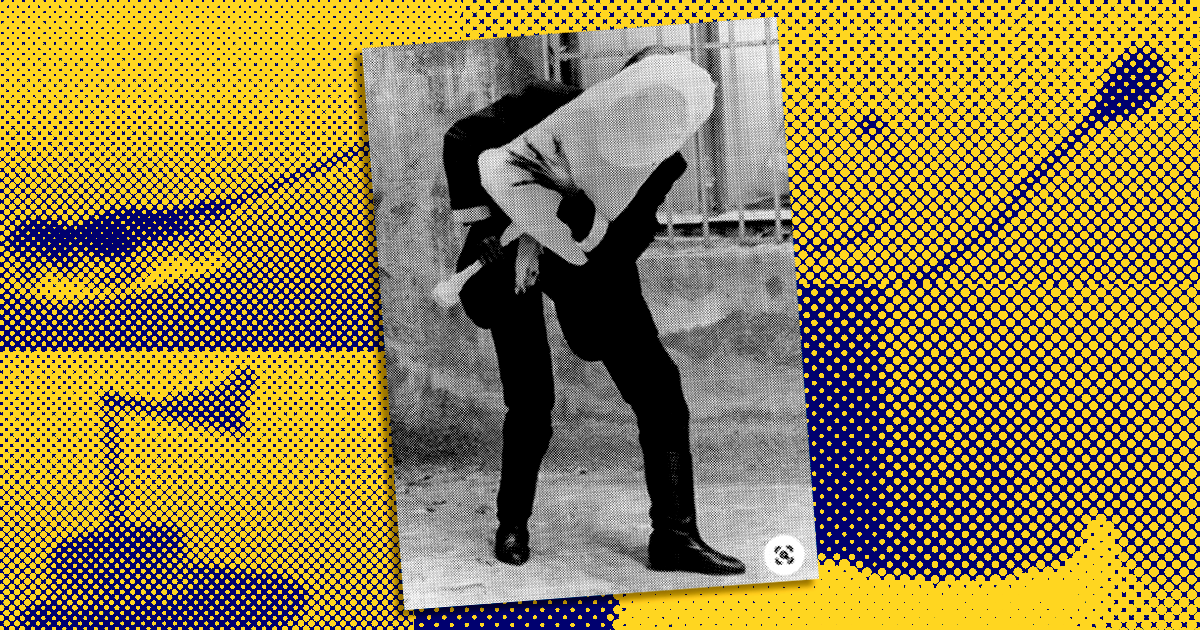
Franz West is known for his playful sculptures, large public works and function pieces of furniture. Born in 1947 in Vienna, he was influenced by the Actionist and Performance Art of the 1960s and 70s, especially those movements based in Austria.
He’s famously quoted as saying “It doesn’t matter what the art looks like but how it’s used,” a tribute to a body of work that examines the interplay between art and social experience, action and reaction. West often covered everyday objects (like bottles, machine parts, pieces of furniture and other bit-and-bobs) with gauze and plaster to make abstract, gnarly sculptures that looked like a tool, instrument or whatever else your imagination might project onto them.
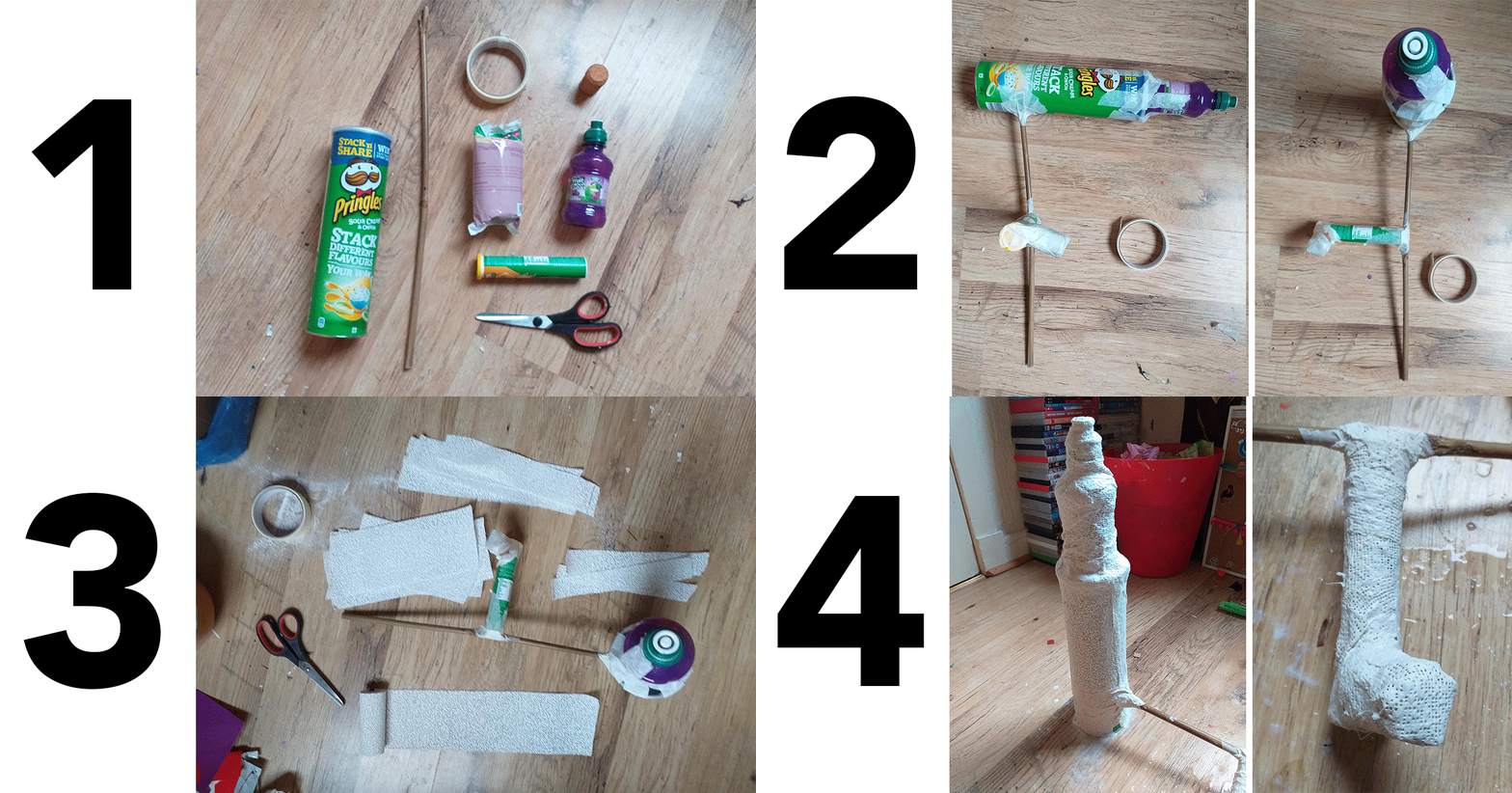
You will need
Household items such as rubbish, recyling, utensils, toys
Plaster/modroc – OR paper mache + white paint
Tape
Camera
A person or your own body
How to:
your chosen objects and tape together. Cover objects with strips of modroc, paper mache or rags soaked in plaster.
Once dry, paint white if not already white.
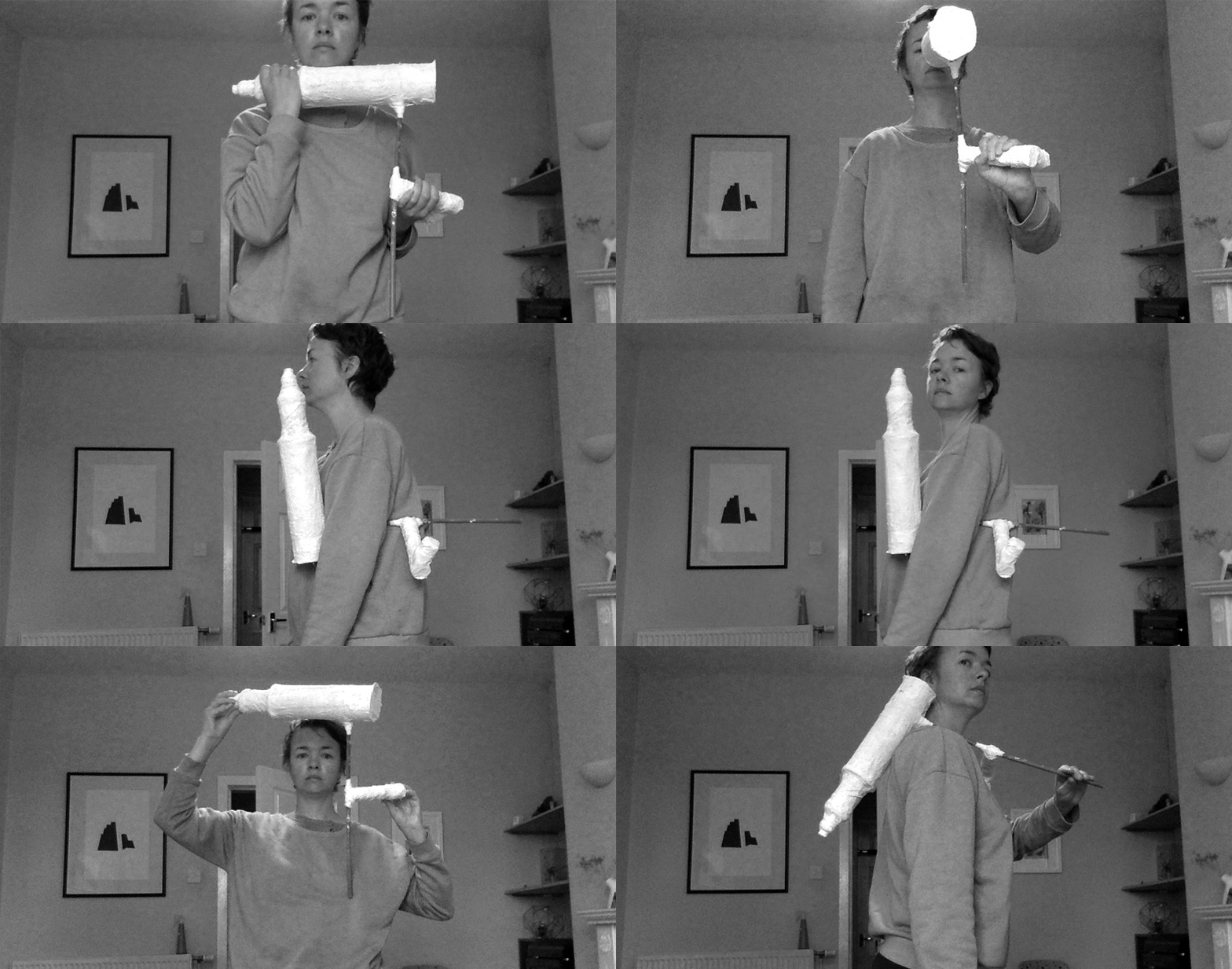
Try out different poses and positions, using your sculpture as either a prop or an extension of your body.
Sculpture Placement Group (SPG) were approached by artist Ally Wallace regarding the planned removal of a sculptural relief by ceramicist William Gordon currently located within Strathclyde University. The relief was installed in the university’s Colville Building in 1967 and was due to be removed in summer/autumn 2018 during a renovation of the building.
SPG undertook a site visit to the building in May 2018 along with Ally and Graham Forsyth, Project Manager at Strathclyde University. The relief was found to be large in scale, intact and fully integrated into the fabric of the building. Overall it appeared to be in good condition and was firmly fixed to the wall. The removal of the relief was planned for August 2018 and Graham confirmed that the plan was for the contractors to remove the wall as they would any other wall without specialist help or advice. We assessed that it was very likely that the relief would be fully or partially destroyed during this process. SPG agreed that we would explore options for removing this work sensitively and storing or rehoming it.
Issues/ Concerns/Challenges/Ethics Identified
Difficulty in Removing the Relief
As outlined above the work appeared to be in good condition and intact. It was made up of different sized and shaped ceramic tiles that were cemented onto the wall, we presume using tile adhesive and grouted into place. The tiles were quite thick and sturdy and were firmly embedded in the fixative. Our initial concern was around the difficulty of removing a work so permanently attached to the wall. It was obvious that to remove all of the tiles in tact would be a painstaking and labour-intensive job and one that would require specialist advice and assistance.
Cost Implications
If a specialist team were to be appointed to assess, survey and eventually remove the relief it was likely to be a time-consuming and costly project. The university confirmed that the current plan was for the contractors carrying out the renovation work to remove the wall ‘as they would any other’ this meant that the relief was likely to be smashed up during its removal. We wondered if there was a ‘half-way’ measure where by a team could be assembled to remove the wall more carefully but not requiring a specialist conservation team which would be outwith the resources available to SPG and the university at this time
Timescale to Rehome
We were contacted about this piece in late May 2018 and the site was due to be handed over to the contractor in August 2018 leaving only around 3 months to undertake research and to explore options for its removal and rehoming and to raise any funds to support this work if possible. At this time Sculpture Placement Group had no funding to pay its members for time spent on the project so time spent on SPG was limited.
Ethical Concerns
SGP had some ethical concerns over the removal of this work in the way that was proposed. Ideally care, attention, specialist advice and skill should have been employed to assess the work and remove it intact.
Actions Taken
Consultation with Strathclyde University
In anticipation of the removal of the artwork the university lasered surveyed the entire relief and also documented it through photography which are now part of the university’s archive. This ensured that there was a record of the work that could potentially be consulted in the future if the work did not survive the redevelopment of the space, which seemed unlikely.
The university has an art collection but had had no dedicated curator for some years. A limited amount of admin that was previously delivered by this role has been taken over by the university’s archivist Victoria Peters. SPG consulted Victoria about the process undertaken to decide the future of the relief. Victoria confirmed that she wasn’t part of the decision-making process which had been the role of the Estates Department of the university.
Victoria’s understanding was that it wasn’t possible to incorporate the relief into the new design of the space and that changing tastes may also have played a part in this decision. She also asked if it might be possible to box so that mural so that it survived for the future but was advised that this was impossible due to issues with the planned use of the space. Victoria confirmed that the Estates department discussed whether they could dismantle the relief and put it into storage but this was discounted this as an option for a number of reasons including the risk of damage when taking it down, a lack of long-term storage locations, the risk of losing components of the relief whilst in storage and finding a suitable location to reinstate it on campus. Victoria said that they felt, understandably, that there was a danger of it languishing in storage for many years with no clear plan for relocating it.
Desk-based research and William Gordon and his work
There is a limited amount of information relating to William Gordon and his work online. William Gordon (1905- c.1993) was a ceramicist who took up the running of the pottery The Walton Pottery Co. in Chesterfield pre and post-WW2. The Walton Pottery closed in 1956 and focused on the creation of industrial ceramics often working in an architectural context and worked with contemporaries including Sir Basil Spence and the Spanish Ceramicist Artigas, a collaborator of Joan Miro. Notable commissions included a large mural commission at St Aidan’s Church in Leicester, the 1958 Basildon Bus Station Mural (now lost) and The Thames and Hudson’s Steps located near the British Museum. Gordon’s work is also included in the collection of the Victoria and Albert Museum, London. According to online sources, despite Gordon’s work now being quite collectable he remains largely overlooked as an artist.
Contacting Artists’ Estate
We also researched if there was any estate to check if any person or organisation was administering the estate of William Gordon. Online checks did not yield any information for William Gordon’s estate, including a search of the DACS database. We also contacted DACS directly to request advice or support on this matter but received no response.
Consulting with Sculpture Conservator
In order to assess best practice and what would be required to safely and responsibly take down the relief we took advice from Glasgow Museums’ Sculpture Conservator Stephanie de Roemer. We asked Steph for her opinion on a number of questions or scenarios that we had imagined in relation to dismantling or repurposing the work as follows, Steph’s responses are included below the headers:
How best to dismantle the work in order that it could be reinstated elsewhere
‘1/ Record the installation in situ: photographs and measurements of wall space/ height. Ideally a schematic drawing and sketch noting also colours of individual components. Take as many measurements as possible: square dimensions (cm2) of each part (or diameter depending on shape) but also depth (cubic dimensions cm3). Ideally you end up with a map and a cross section (to show depth). You can also record the outlines of components with Melinex (see through sheet) and permanent marker pen. You never can take enough photographs (!) but do remember when taking pictures to have something to orientate the detail of the image to the overall artwork.
2/ Assess feasibility of removing the entire wall in sections instead of individual components from the wall. This is faster and more suitable when there is a lot of time pressures. You require heavy masonry cutting equipment, but you also need to protect the artwork by cladding the front with suitable materials prior to their removal: this is not a DIY option! You’ll have to get people to do this who are trained in the use of the equipment and the appropriate safety and preparation measures.’
What are the ethical issues around repurposing the work or the materials it is made of?
‘This is where the detailed recording would become invaluable: you can use the recording (hotographs, dimensions, sketches, angles etc to reconstruct the iteration of the artwork from that space. It is a restoration of a historic iteration only, and you would have to label or communicate it as such. This obviously raises questions as to its authenticity. However recording the story behind the change in site and location and restoration would become your link to the physical altered appearance and on more intangible, conceptual and philosophical considerations transition the authenticity through the narrative and changes in values (demolishing of building and art work), which means the art work continues to exist – maybe not as a physical entity – but in drawings, records, filming? Interviews with current stakeholders? Artist? Estate? Visitors? etc
Alternatively with all the information available from a thorough documentation and recording and in conversation with the artist/ artist estate there may be an interesting project in thinking of updating the physical iteration of the artwork in a new space and by remaking and re fitting remade components. The physical correctness in line with traditional ideas of ‘restoration’ is not relevant in this case. It is much more about having conversations as to what the artwork expressed in the first place (artist intent) and how this translates into 2018: this would provide much scope for discussions and engagement opportunities with many stakeholders, future stakeholders, etc which would provide the objectives as to what may be done and/ or happen with the art work or in many ways even re-animate the installation as art at work.’
What is required for the university to fulfill its duty of care to the artwork?
‘The only thing I could think of is if they fulfilled their duty of care for this artwork by going through a de-accessioning process which means that first there is a case made to offer the work to other institutions, organisations, galleries, museums, etc. However if this work has never been accessioned fully as an ‘art work’ then it doesn’t have the status of one, and will be fully ok to be removed as part of a refurb of the space and it’s furnishings and fittings.’
Research with Platform about the Easterhouse Mosaics
Platform are an arts organisation based in Easterhouse, Glasgow. In 2012 they commissioned Glasgow-based artist Alex Frost to create his first permanent public artwork in response to the Easterhouse Mosaic (1983-2004) a celebrated community artwork. In response Frost created ‘The Old & New Easterhouse Mosaic (and everything in between)’, an ambitious new project that included ‘The New Easterhouse Mosaic’, a permanent mural outside The Bridge; a series of wax crayon on paper rubbings taken from over 60 existing mosaics in the area; a field guide to these mosaics and an archive dedicated to the old mosaic.
We thought that the approach adopted by Platform to this new commission based on a lost artwork was interesting and of relevance to the potential and imminent loss of the relief by William Gordon at Strathclyde University. To find out more we contacted Platform’s curator Margaret McCormick to find about why they had decided to commission a new work, rather than reinstate the original mosaic. Margaret highlighted that the issues around the loss of the mosaic were still a very sensitive within the local community:
History of the Original Easterhouse Mosaic
The original Easterhouse mosaic was created in collaboration between artists and young people from the Lochend area and was at the time, the largest mosaic in Europe at one point. There is an essay written by David Harding that gives a really interesting insight. The project was part of a YTS project but once that finished the artists and young people continued to work on it to complete the finished piece. It became loved by the community and local residents and was never damaged with graffiti or vandalism. In 2004, the mosaic was taken down to make space to build new houses at which point some of it had begun to crumble due to dampness in the wall that it was adhered to. Even though the council were advised the best way to take the wall down, they bulldozed it resulting in each section being pretty much destroyed. At the time, local people were of the understanding it would return but this did not happen. Because no one knew what happened to it, when Platform commissioned the project with Alex Frost, many locals were upset to hear that it was pretty much destroyed and that only limited sections of it still exists.
About the New Commission
As the main arts company in the area Platform were given the mosaic to ‘look after’. They took professional advice and and were told that recreate the mosaic would cost thousands. this along with the fact that its original site was now new housing deemed that the original mosaic would not be able to be reinstated. Platform still have large pallets that Glasgow City Council stored the remnants of the the mosaic in and sadly, much of it is rubble. Platform advise that on examining some of the sections, you can see how detailed and beautiful, a wonderful presence it must have had within the community.
Although it would not be possible to reinstate the original mosaic Platform looked to sensitively celebrate the past mosaic which this led to them commissioning Alex Frost to make a new public artwork. Frost found during his research found that there were many mosaics in and around Easterhouse that were produced through various community projects. He also tried to contact everyone that was involved with the original mosaic. This posed some challenges as some artists felt that it was their artwork / mosaic (singular) whereas other people were vocal in saying that the artwork was collectively created and that it belong to the people of Easterhouse.
The archive material that Platform has on the original mosaic is really limited and we felt we couldn’t get involved with individuals from the original project as it was very much a group project involving many people which they did not have the capacity to replicate.
As part of the Frosts’ commission Platform tried to celebrate the old mosaic and did restore some larger pieces that people could view.Ideally, we were looking donate them to local schools and so on. A local housing association has taken some parts as part of their community garden.
Research with Edinburgh University about the Paolozzi Mosaic
Edinburgh University have become custodians for sections of mosaic by the important Scottish artist and sculptor Eduardo Paolozzi. These were originally installed as part of a large (950m) public artwork created by Paolozzi at Tottenham Court Station in 1986. As part of the plans for enlarging the station in 2017, two arches that formed part of the mosaic were required to be removed. An additional section of the mosaic was also carefully removed and re-sited in another part of the station. The ‘arches’ were removed and given into the custodianship of Edinburgh School of Art where Paolozzi studied and taught. ECA was deemed and appropriate custodian for the work due to its long-standing relationship during the artists’ lifetime and subsequently with his estate. We consulted with Liv Laumenech, Public Arts Officer at Edinburgh University to find out the background to this acquisition and their approach to preserving the re-presenting these parts of the mosaic.
On consulting with Liv she informed that when the announcement of the redevelopment of the station was announced in 2011 the Paolozzi Foundation consulted with Transport for London and agreed that the arches would be removed. In early 2015 the arches were closed. At their next meeting with Transport for London, The Paolozzi Foundation were informed that the arches had been removed without further consultation, proper planning or a conservator on site. They were informed that a photographic survey of the arches was undertaken in 2011 but to date, this has not be shared with anyone.
Following this, the 20th Century Society put out a call to find a new home for the arches to which ECA responded and was selected based on the case that their former Head of Collections Neil Lebeter made. At this point the mosaics had not been seen since March 2015 and were laid out on pallets attached to concrete. Upon assessment, it was found that there had been no consistency as to how they had been removed and most of the remaining sections were around hand-held size and had obvious traces of their removal such as chisel and angle-grinder marks. The sections had not been labelled or ordered and what arrived at in Edinburgh was like a giant jigsaw puzzle that needed to be put back together. The pieces were photographed by ECA’s School of Infomatics who put the images through image matching software to identify how to reconstruct the arches. This process confirmed that only 33% of the arches had survived the dismantling process. Given that such a small amount of material survived stretched across the two arches it would be difficult to reconstruct them as you lost any sense of the design.
The next step was for ECA to decide what to do with the remaining sections and to do so they consulted with students, experts and members of the public. They hosted talk sessions with various organisations including the British Association of Modern Mosaics. They raised the issue at the Vandalism and Arts Conference through the submission of a paper, in order to try to gain a consensus. Lastly, they hosted a symposium event in February 2017 with key figures in the production and preservation of mosaics and the 20th Century Society, university staff and the public.
The consensus that emerged through this research and consultation was that to remake or reconstruct the arches was not a viable option as so little of the original material survived. There was also a suggestion that they could construct a ghost arch to show how the originals would have looked, incorporating the surviving material and leaving gaps. However the preferred option was to use the material to commission something new.
This could perhaps be viewed as a controversial option. However, it was deemed appropriate due to Paolozzi’s democratic way of working, his use of reconstruction and his reuse of materials. ECA now plan to launch an invited competition for an artist to create a new work from the surviving mosaic pieces. This new public work will be sited at ECA and Liv is currently exploring options for an appropriate site.
Summary of Findings & Learning for SPG
This case has allowed us to assess the list the challenges that the dismantling of permanent public sculptures, integrated into the fabric of a building can pose. It has highlighted issues of conflicting priorities between the need to conserve such works and the priorities of property or estate development. Often the value of such works, to communities and the cannon are not fully appreciated or overlooked in favour of economic factors and the requirement to deliver such developments in a timely fashion. As demonstrated in the small sample of works we examined the the results of this can be catastrophic for the artwork and the community it serves. Key issues identified by SPG that contribute to this are as follows:
A lack of guidance or control when works are not accessioned
The favouring/value of one particular type of work over another which is often subject to personal taste or fashion
A lack of transparency and communication with professionals or interested partners or stakeholders
Economic factors including prohibitive costs of assessment, dismantling and re-siting works by trained professionals
Ethical issues surrounding the resisting of works or reuse of materials, particularly when the artist is deceased.
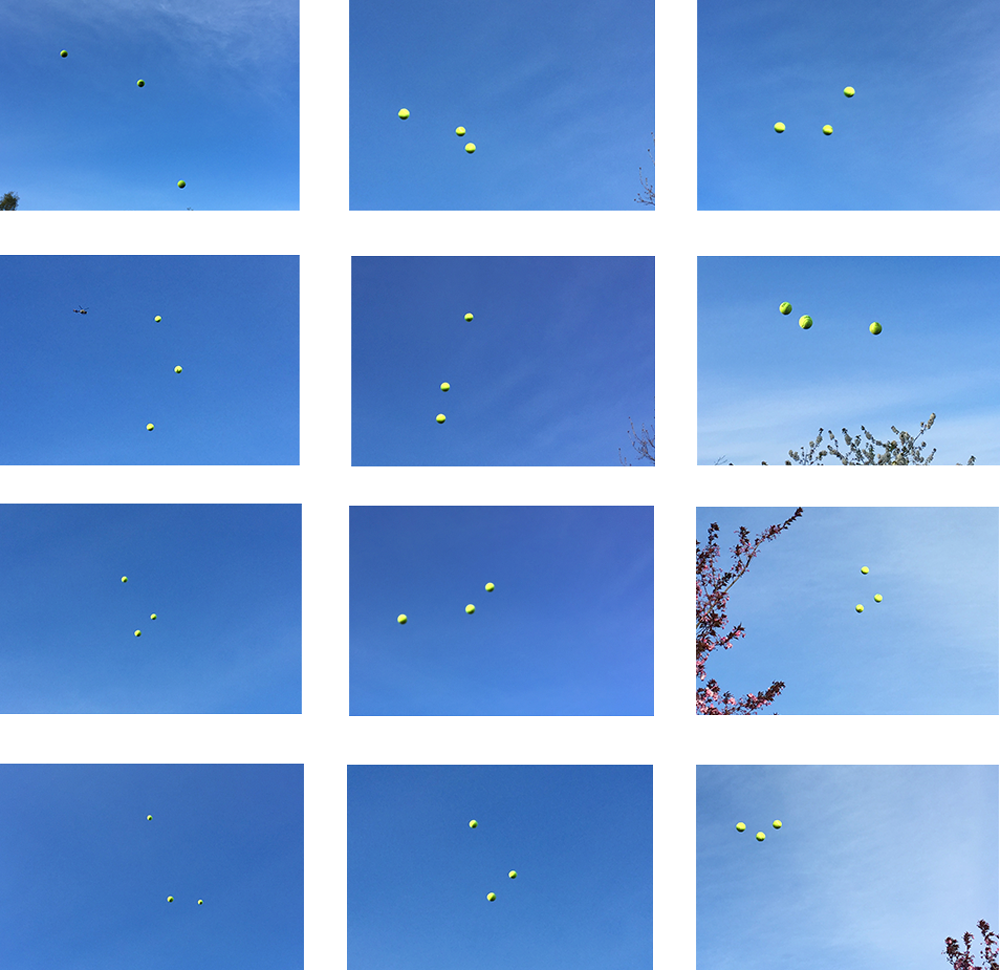
For this recreation we move away from the “sculpture” of the title in true Baldessari style. John Baldessari is considered a forerunner of conceptual art in the 1960s, his work spanned across the latter decades of the 20th Century and into the early part of the 21st Century. The majority of his long life was spent in California were he taught at CalArts.
This project takes inspiration from his 1970s photo based works, which are seen as key in the development of appropriation art and other practises that address the social and cultural impact of mass media. His work explores language, both written and visual, questioning the very nature of communication. Using humour to disarm the viewer, Baldessari seeks to challenge the way which we receive and interpret information. There’s always variations within each series of his works, he wasn’t concerned with creating a singular masterpiece but exploring an idea in multiple ways.
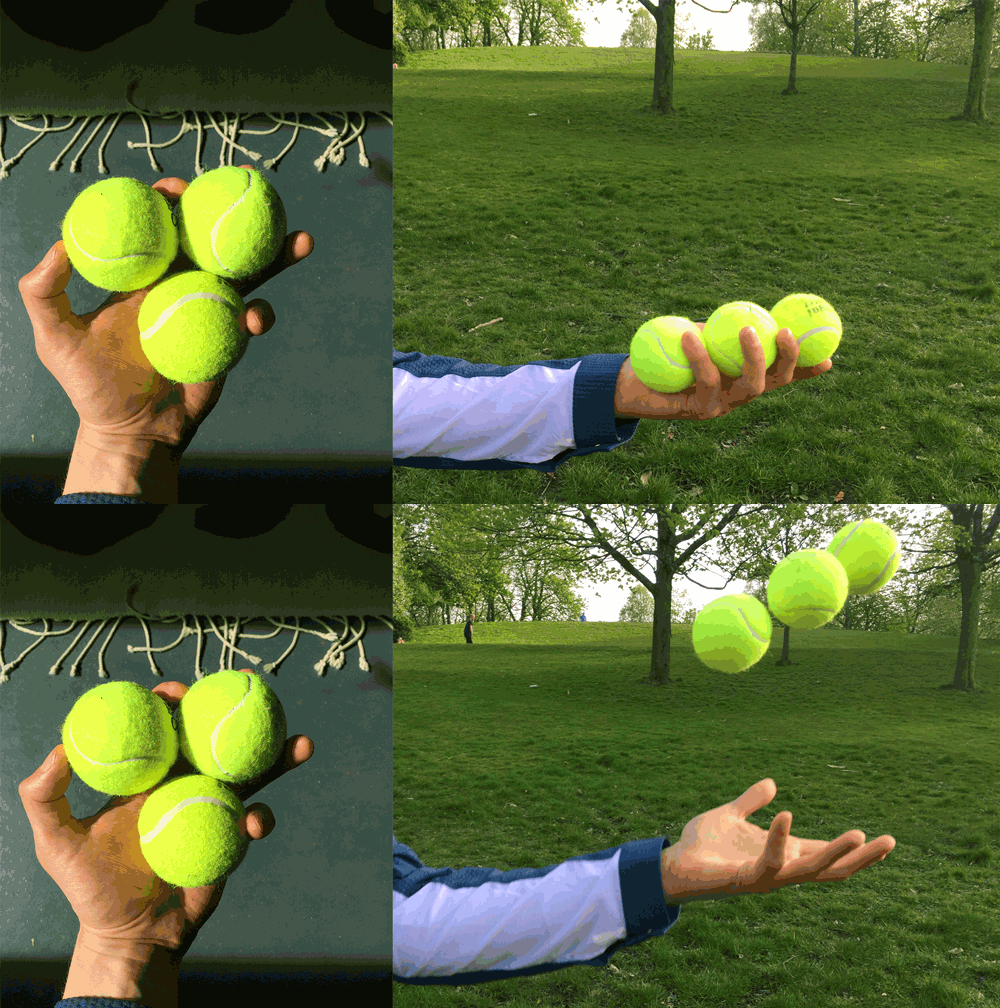
The work were recreating is Throwing Three Balls in the Air to Get a Straight Line (Best of Thirty-Six Attempts) (1973), the works plays with the medium that captures it. They allude the lexical promise of the work’s title, instead the images themselves have a musical quality, like points of notation, or some kind of graphic score set in the Californian blue skies. An improvisation that’s been selected and edited by the photographer. The seemingly absurd and random acts of throwing balls into the air uses the comedic to point to the tragic absurdities of life’s accumulations.
You’ll need:
3 balls, any type will do
A public park, your street, your garden, anywhere with a little space and a view of the sky.
Something to take the photos with.
Find a good spot where you can capture the balls in flight.
Spirit of St. Kentigern at its original location on Buchanan Street, images courtesy of The Herald and Glasgow Live.
In 1974 a competition was launched by the Glasgow Museums in association with Glasgow Corporation’s Civic Amenities Committee to create a ‘special feature’ of the new Buchanan Street pedestrian precinct. The competition was open to all sculptors working in Scotland. 29 entries were received, 3 finalists were shortlisted and Spirit of Kentigern, a 5m high bronze sculpture on a cyclopean sandstone pedestal by Neil Livingston (b. 1954) was selected as the winning work.
Spirit of Kentigern was unveiled by Lord Provost David Hodge on 8th October 1977 and the plaster maquette for the piece was gifted to Glasgow Museums and Art Galleries in the same year. The piece became one of Glasgow’s most controversial pieces of public art, loved and loathed in equal measure. Nonetheless it became a well known local landmark, a meeting point and a recognisable location marker, helping people navigate their way around the city.
In the year 2000 the sculpture was removed as part of a refurbishment of the pedestrian precinct, put into long-term storage in a field within the grounds of Glasgow Museums’ store on Lochburn Road, Maryhill and was largely forgotten.
In 2014 Martin Craig, Kate V Robertson and Michelle Emery-Barker were undertaking research for Reclaimed- the second life of sculpture as part of Glasgow International Festival of Visual Art. Reclaimed was to include only works in long-term storage, work that had no planned future and that might otherwise be completely forgotten. They had heard a rumour that Spirit of Kentigern, a work that they all remembered from their childhoods, was languishing in a field.
The group were put in touch with Dennis McCue, from Glasgow City Council’s Land Services Department who had been keen to raise awareness of Spirit of Kentigern’s plight and if possible find it a new home. Dennis took them to the Maryhill Stores to view the work but when they got there it was missing. They were told that men had come on a truck and taken it away and the fear was that it had been stolen for its scrap metal value. After a nerve-wracking hour or two it was finally tracked down at another council store in the North of the City and the group travelled to see it lying like a stranded whale on its side in and overgrown field.
Spirit of St. Kentigern as part of the exhibition Reclaimed – The Second Life of Sculpture that was part of Glasgow International 2014.
The work was included in the exhibition and proved to be one of the most popular sculptures included. During the exhibition a trustee of Glasgow City College spoke to the group asking if the sculpture was available as he was interested in putting it forward to be permanently sited within their new campus which was due to begin development very soon.
In 2017, Spirit of Kentigern found a new permanent home in the campus of Glasgow City College, sitting proudly at the front entrance of the new building as if it should always have been here. The story of Spirit of Kentigern demonstrates how the lifespan of an artwork can be extended and how, if given the chance, works can take on new meaning and find new audiences.
The Sculpture Placement Group team with the Spirit of St. Kentigern at its current site the City of Glasgow College.